
New Kent County Court Records After a Jail Arrest
New Kent County does not operate its own jail. A person arrested on a New Kent charge is commonly booked into Pamunkey Regional Jail in Hanover County, while the court case remains a New Kent County matter. That split is important. The jail record documents custody, intake, and sometimes a public roster entry. The court record documents the charge as it is filed, tracked, heard, amended, dismissed, or resolved.
The official prosecution channel is the New Kent County Commonwealth's Attorney. Virginia uses Commonwealth's Attorneys rather than District Attorneys, and the current officeholder identified in county records is T. Scott Renick. The office prosecutes felonies and may prosecute Class 1, 2, and 3 misdemeanors in New Kent County. For a person researching court records after a jail arrest, the prosecutor's role explains why a jail-listed allegation can change once formal charges are evaluated.
For the custody side of the same event, use jail inmate records to understand the Pamunkey roster and custody contacts. For booking photos, use jail roster mugshots. The court record is the better source for charge status, hearing dates, disposition, fines, costs, appeal path, and whether a capias or failure-to-appear event has become part of the case history.
How to Find Court Records After an Arrest
The main official starting point for many New Kent criminal and traffic matters is the Virginia General District Court Online Case Information System. Virginia court materials say General District Court cases may be searched by name, case number, or hearing date. This matters for misdemeanors, traffic/criminal matters, preliminary hearings, and early post-arrest records. The statewide Virginia Case Status and Information page also links to adult criminal case access in district courts and select circuit courts.
For New Kent Circuit Court records, the county clerk channel is separate. The official New Kent Circuit Court Clerk page says public civil and criminal records are available in person. Copies are listed at $0.50 per page, with an additional $2.00 certification fee. Written requests need a specific book and page reference, payment, and a self-addressed stamped envelope, and the clerk page states that fax copies are not provided. The New Kent Circuit Court remote access portal requires a username and password and states that official records remain at the clerk's office.
- Search the General District Court system by defendant name, case number, or hearing date when the matter is likely in district court.
- Check the Virginia Case Status and Information page when the case may have moved between district and circuit channels.
- Use the New Kent Circuit Court Clerk for felony circuit files, older records, certified copies, and in-person public-record access.
- Compare the charge text, code section, hearing dates, and disposition with any jail or arrest information instead of assuming the records match word for word.
The court search screen is not a jail roster. It usually will not answer whether a person is still housed at Pamunkey, whether a bond has already been posted, or whether a booking photo exists. It is most useful once a charge has entered the court system and can be tracked as a case.
The Virginia General District Court search page is shown in the official capture from Virginia's GDC case information system.
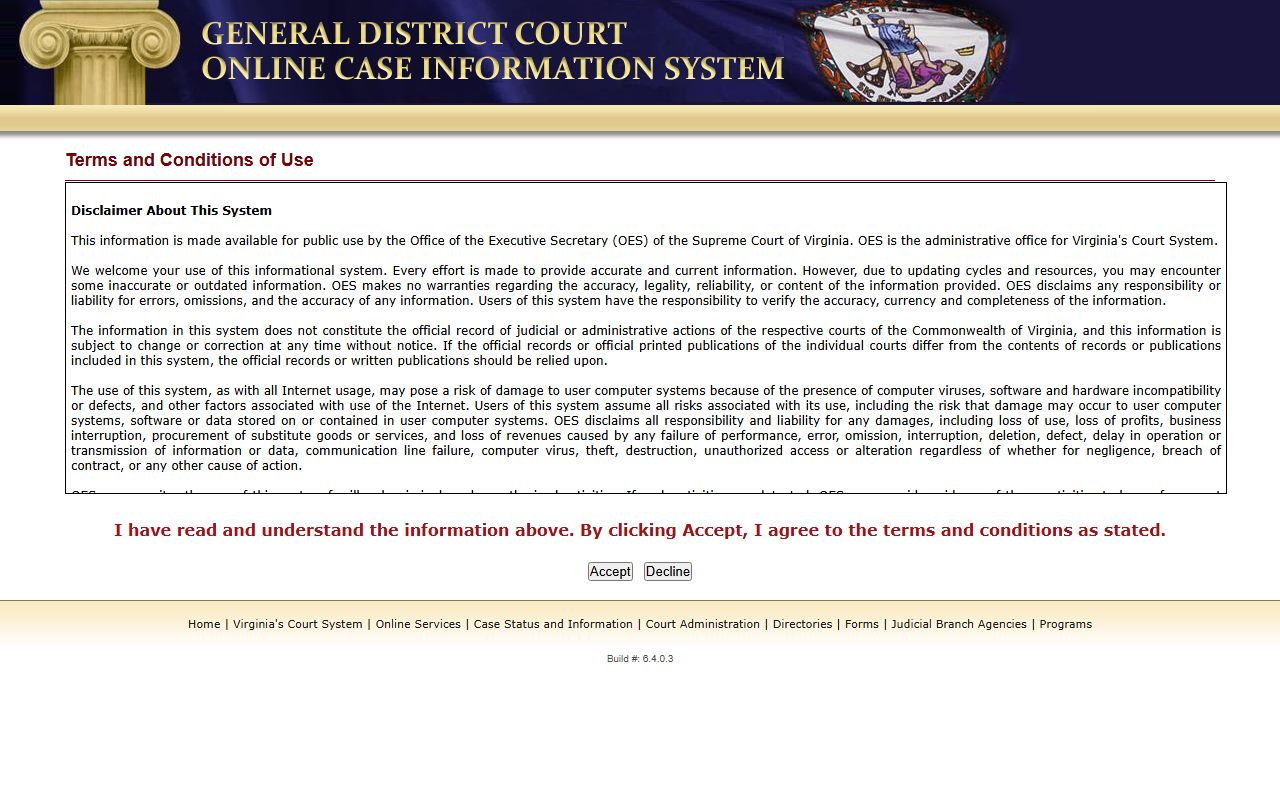
The search fields shown there are the practical bridge between a New Kent arrest and the court record that follows, especially when the public jail profile does not show charge or bond fields.
Court Search Fields for New Kent Arrest Cases
Search fields vary by court channel, but the research located a clear field inventory for the official Virginia and New Kent systems. Use the narrowest accurate identifier first. A case number is stronger than a common name, while a hearing date can help confirm that the match is the right defendant and court.
| Portal | Field Label | Type | Required | Notes |
|---|---|---|---|---|
| Virginia GDC case information | Name | Text | Search-dependent | Useful when no case number is known. |
| Virginia GDC case information | Case Number | Text | Search-dependent | Best when a summons, warrant, or clerk notice provides the number. |
| Virginia GDC case information | Hearing Date | Date | Search-dependent | Helps confirm court activity after an arrest. |
| New Kent Circuit remote access | UserName | Text | Yes | Remote access requires login credentials. |
| New Kent Circuit remote access | Password | Password | Yes | Official records remain at the Circuit Court Clerk's Office. |
How Charges Get Filed After an Arrest: Complaint, Information, and Indictment
After the arrest and booking stage, the charge record belongs to the court process. A law-enforcement officer, magistrate, prosecutor, or grand jury may be involved depending on the offense and the procedural stage. The Commonwealth's Attorney can evaluate the case, subpoena witnesses, and decide how to proceed on charges within the office's authority. That is why a jail charge, an early court entry, and a later circuit record may not use identical wording.
| Document | Who Uses It | Common Role | What to Check |
|---|---|---|---|
| Complaint or warrant | Officer, magistrate, or prosecutor process | Begins or supports an accusation after arrest or warrant service. | Offense wording, code section, date, and issuing court. |
| Information | Prosecutor | Formal charging document used when allowed by procedure. | Whether the filed charge differs from the arrest allegation. |
| Indictment | Grand jury | Moves a felony into circuit court after grand-jury action. | Charge level, count numbers, amended language, and arraignment dates. |
Do not treat any of these documents as a conviction. They identify accusations or formal charges. A conviction requires a guilty plea, verdict, or other final finding entered by the court.
Charge Status in Court Records After an Arrest
Charge status can change many times after a New Kent jail arrest. A booking entry may reflect the reason the person entered custody, while the court file reflects what was formally filed and what happened next. Charges can be amended, reduced, certified, indicted, dismissed, continued, or resolved by plea or trial. When a charge appears in more than one court, read the dates and the court level carefully.
| Status | What It Means | Practical Reading |
|---|---|---|
| Pending | The charge remains open and has not reached final disposition. | Look for the next hearing date and any bond condition changes. |
| Amended or reduced | The charge wording, code, or level changed during prosecution. | Compare the original arrest allegation with the current court entry. |
| Certified or indicted | A felony matter moved toward or into circuit court. | Search circuit records in addition to the district case entry. |
| Dismissed | The court ended that charge without a conviction on that count. | Other counts or related cases may still be pending. |
| Nolle prosequi | The prosecutor declined to continue that charge at that time. | Read the docket and consult the clerk for exact procedural effect. |
| Convicted | The charge ended in a guilty finding, plea, or verdict. | Check sentence, fines, costs, probation, and appeal information. |
Bail and Release Records After a Jail Arrest
Bail is a court and magistrate issue as well as a jail custody issue. Virginia Code Section 19.2-120 establishes admission-to-bail rules and factors, while Section 19.2-124 addresses appeals from denial of bail, excessive bond, or unreasonable recognizance terms. In practical terms, a person may be releasable on recognizance, unsecured bond, secured bond, surety bond, or held without bail until further court action.
Pamunkey's inspected public roster did not expose bond fields in the accessible profile text, so a public web listing may not be enough to determine release terms. Confirm active bond with Pamunkey inmate records or the court that set the terms. Also ask whether a detainer or hold from another locality, VADOC, USMS, or ICE would prevent release even if the local bond is posted.
| Bond Type | How It Works |
|---|---|
| Recognizance | Release on a signed promise to appear and follow conditions, without paying money up front. |
| Unsecured bond | A bond amount is signed for, but payment is usually triggered only by a violation or failure to appear. |
| Secured or cash bond | Money or collateral must be posted before release. |
| Surety bond | A licensed bondsman or approved surety guarantees the bond. |
| No-bond hold | Release is unavailable until the court changes the order or the hold is resolved. |
Warrants, Capiases, and Court Records After Arrest
No official New Kent County active-warrant database was located in the research. The Sheriff's Office has public outreach channels, but those should not be treated as a complete warrant list. For official routing, call the New Kent County Sheriff's Office at 804-966-9500. For court-linked warrants, search the General District Court and circuit channels, because bench warrants and capiases often tie to an existing case.
A capias is a court order directing arrest, often after failure to appear or another court-related violation. An arrest warrant authorizes arrest based on an alleged offense. A search warrant authorizes a search and does not necessarily mean the person is in custody. A fugitive warrant may involve another jurisdiction. If a warrant has already resulted in arrest and jail commitment, the person may appear on the Pamunkey roster, but the warrant history and next court date should be checked in court records.
Warrant caution: Do not appear at a jail or courthouse assuming a warrant can be cleared informally. A suspected active warrant or capias can result in immediate arrest and transport to Pamunkey.
Charges vs. Convictions
A charge is not a conviction. A New Kent arrest may create a booking record and a court case, but the defendant is not convicted unless the court enters a guilty finding, guilty plea, or verdict. This distinction is central when reading court records after a jail arrest, because early records can show accusations that are later reduced, dismissed, or not prosecuted.
| Charge | Conviction | |
|---|---|---|
| Stage | Accusation or formal count in a case. | Final guilty finding, plea, or verdict. |
| Proof level | May begin from probable cause or a charging document. | Requires the legal standard for guilt in court. |
| Record meaning | Shows what was alleged or filed. | Shows the resolved outcome for that count. |
| Common mistake | Assuming a booking charge proves guilt. | Ignoring sentence, appeal, probation, or later relief. |
Sealed vs. Expunged Arrest and Court Records
Virginia public access rules do not mean every record stays public in every form. Juvenile matters, sealed records, expunged records, victim-sensitive material, investigative material, and central criminal-history database information may be restricted. For dismissed or otherwise eligible matters, a person may need to pursue the court process for sealing or expungement rather than asking a jail roster to rewrite the court history.
| Sealed | Expunged | |
|---|---|---|
| Visibility | Hidden from ordinary public access by court order or rule. | Removed from public treatment under the applicable expungement process. |
| Effect on public searches | May no longer appear in ordinary public case access. | May be treated as if the qualifying record is not publicly available. |
| Agency access | Some limited official access may remain depending on law and order. | Access depends on the expungement statute and court order. |
| Best channel | Ask the court clerk about the order and public-record effect. | Use the court process and verify completion with the originating office. |
Restricted Court Records After an Arrest in New Kent County
Virginia FOIA, Code of Virginia Title 2.2, Chapter 37, supports access to public records unless a statutory exemption applies. Section 2.2-3706 governs disclosure and limits for law-enforcement and criminal records. That statute is important for arrest, incident, and booking-record requests, but it does not make every criminal-justice image, juvenile matter, investigative file, sealed case, or protected victim record public online.
Use the official system that created the record. Custody and current roster questions route to Pamunkey Regional Jail. Arrest reports and Sheriff's Office records route to Sheriff Lee S. Bailey under the New Kent Sheriff's Office FOIA process. Formal charges, hearing dates, and dispositions route to Virginia courts or the New Kent Circuit Court Clerk. When records conflict, the court record usually controls formal charge status, while the jail and sheriff records explain custody and arrest context.
Background Check Considerations
Casual court-record lookups are not the same as regulated background checks. A public case search may show a name match, charge status, or disposition, but it does not verify identity for employment, housing, credit, insurance, licensing, or other regulated screening. Name-based searches can also produce false matches, especially when a common name appears without a date of birth or case number.
Important: This website is not a consumer reporting agency and must not be used for FCRA-covered eligibility decisions.